
The Youth Development Policy Agenda
YOUTHOOD’s ten long-term priorities for stronger, more relevant, rights-based and rooted youth development across the United Kingdom
Young people’s lives are shaped across education, housing, health, employment, transport, justice, community life, digital spaces and public policy. Yet the systems surrounding them are often developed, delivered and assessed separately.
The Youth Development Policy Agenda sets out YOUTHOOD’s enduring national position on the changes needed to create a more connected, developmental and rights-based approach.
Its ten priorities bring together national leadership, policy scrutiny, meaningful youth influence, intergenerational development, regional coordination, equitable access, supported transitions, institutional practice and long-term accountability.
Why We Created The Agenda

Youth development is often treated as a collection of separate services, programmes and policy concerns.
Education policy may focus on attainment.
Employment policy may focus on entry into work.
Health policy may focus on treatment access.
Youth services may focus on participation.
Each matters, but young people experience their combined effects within one life.
The Youth Development Policy Agenda responds to this fragmentation.
It sets out the structural, institutional and practice changes YOUTHOOD believes are required to strengthen how youth development is understood, enabled and assessed across the United Kingdom.
The Agenda is not tied to one government, department or political cycle. Its priorities are intended to remain stable while their supporting evidence, mechanisms and recommendations grow through national conversation, research and practice.
The Agenda moves beyond asking what government should provide for young people. It asks how the systems surrounding young people should be organised, connected and held accountable.
Grounded in YOUTHOOD’s Wider Delivery Work.
The Agenda is informed by YOUTHOOD’s connected policy and practice architecture.
Our frameworks do not sit separately from our policy position. They provide the developmental reasoning, participation methods and practice tools through which the Agenda can grow.
-
Establishes why we exist, and why youth development should be treated as a serious social, institutional and public policy responsibility.
-
Provides the developmental, ethical and rights-based architecture underpinning the Agenda, including the Youth-Facing Landscape, Turning Points, Natural Equity and shared developmental outcomes.
-
Provides the journey through which young people’s insight should reach decision-makers, shape decisions and receive visible feedback and accountability.
-
Provides an intergenerational method through which lived adolescent and professional insight can develop separately before converging around shared understanding and recommendations.
-
Provides practical expectations for reducing barriers created by travel, location, cost, short notice and inaccessible opportunity design.
-
Develop individual priorities in greater depth and respond to emerging national policy conversations.

The Ten Priorities for National Youth Development Reform
-
![]()
01: Establish an Office for Youth Development within the Cabinet
Create permanent national stewardship for youth-impacting policy across government, with clear responsibility for coordination, scrutiny, accountability and continuity.
-
![]()
02: Create a Protected Developmental Enrichment Curriculum
Guarantee protected time within the school week for personal, physical, civic and skills development alongside academic education.
-
![]()
03: Create a Cross-Government Youth Development Duty
Require departments to examine children’s rights and developmental effects, ensuring that significant policy and legislative decisions account for their combined impact.
-
![]()
04: Establish a National Standard for the Insight-to-Influence Journey
Ensure that youth participation travels beyond consultation towards visible influence, meaningful feedback, institutional accountability and a clear understanding of tangible impact.
-
![]()
05: Make Intergenerational Policy Development Standard Practice
Bring lived adolescent and professional insight together through structured reflection, enabling stronger shared understanding, more grounded policy recommendations.
-
![]()
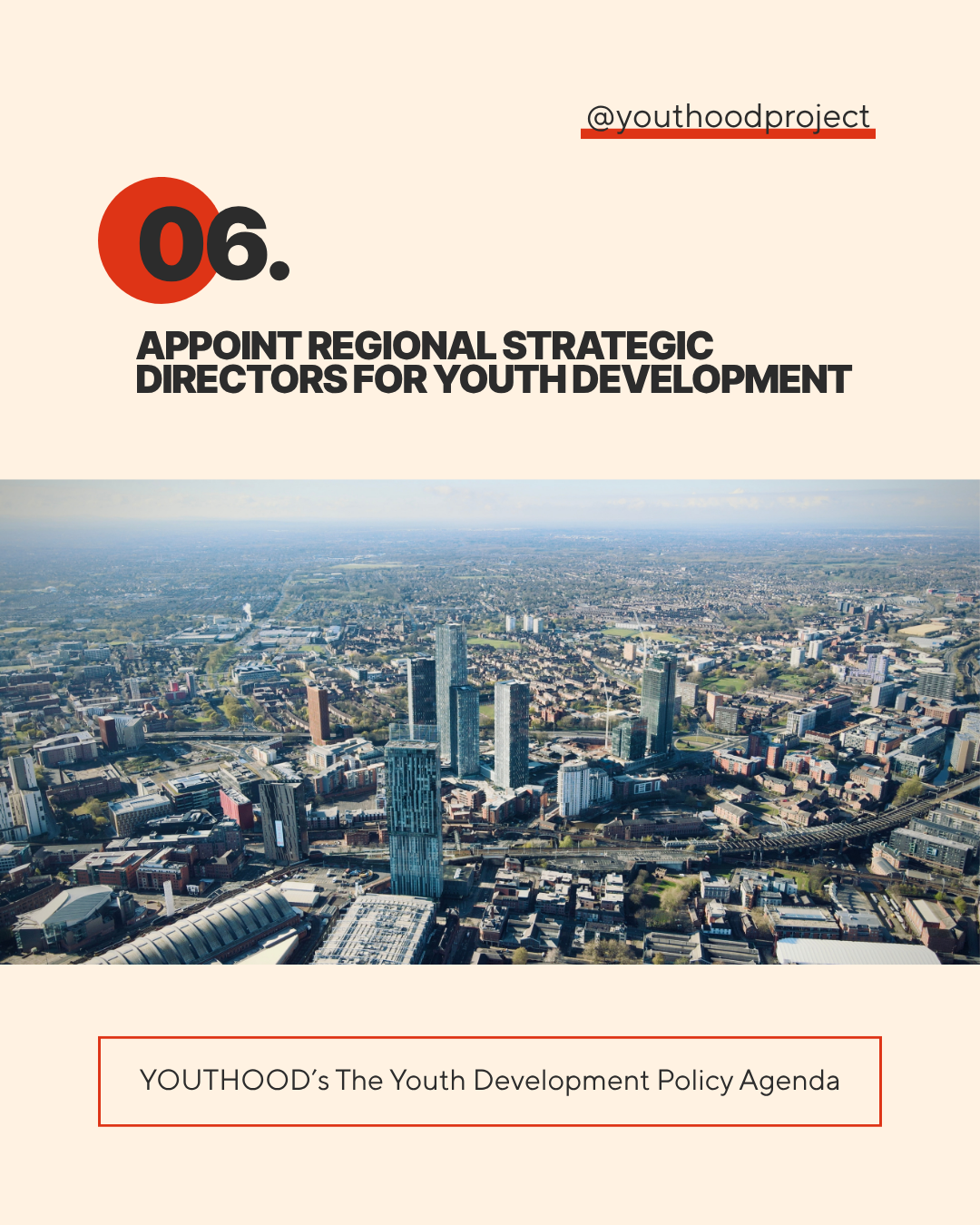
06: Appoint Regional Strategic Directors for Youth Development
Create named regional leadership with the authority to coordinate policy, align resources and lead regional youth-development coalitions.
-
![]()
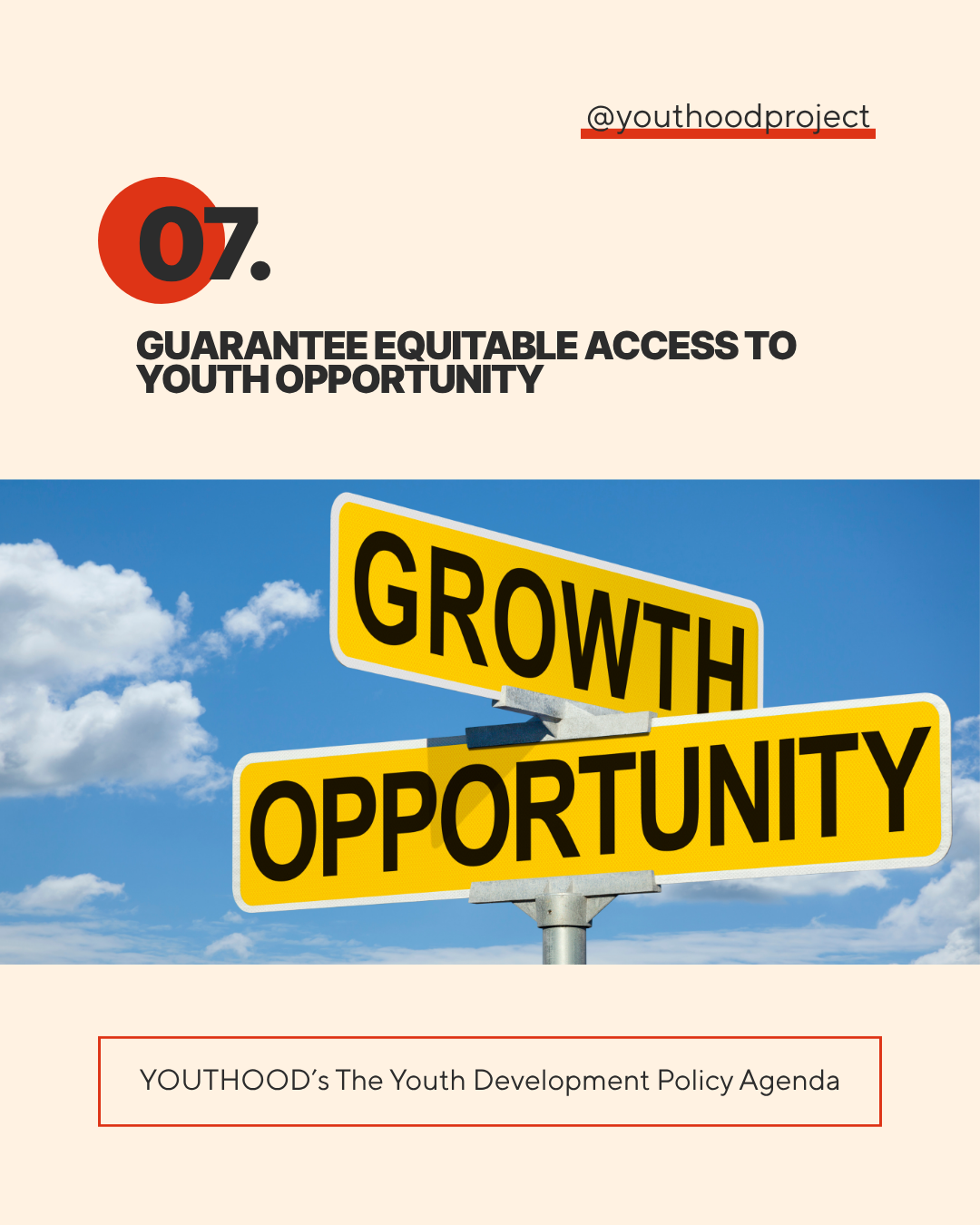
07: Guarantee Equitable Access to Youth Opportunity
Remove avoidable barriers created by travel, location, cost and timing, ensuring that opportunities can be discovered and meaningfully accessed by youth from different circumstances.
-
![]()
08: Establish a National Turning Points and Transitions Guarantee
Protect continuity, relationships and responsibility when young people move between services, systems and developmental stages.
-
![]()
09: Establish a Rights-Based Joined-Up Youth Development Standard
Place the UNCRC and shared developmental practice at the centre of how youth-facing institutions work together, make decisions and uphold young people’s rights.
-
![]()
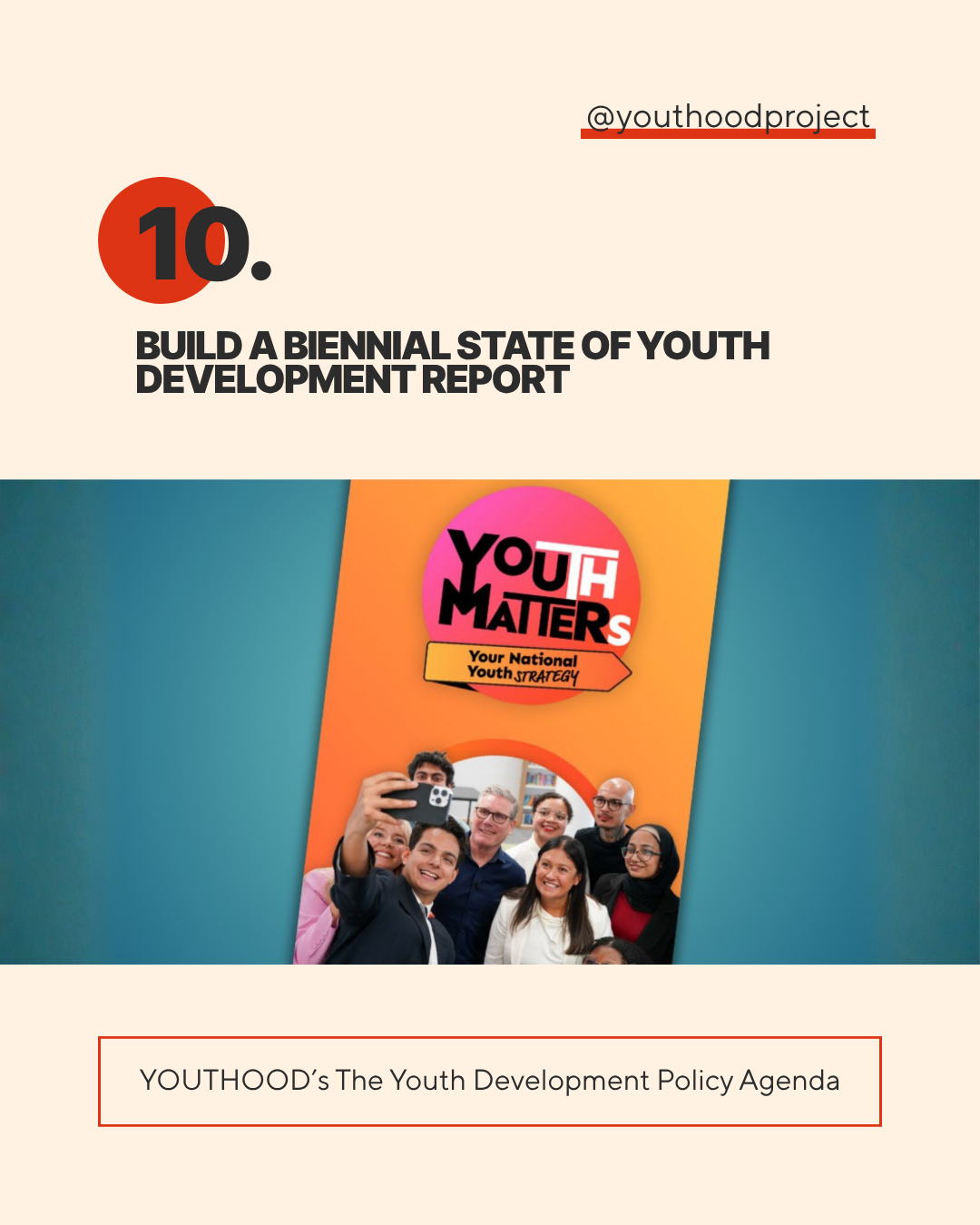
10: Build on Youth Matters Through a Biennial State of Youth Development Report
Create a shared outcomes framework and a meaningful two-year cycle of national evidence, scrutiny and public accountability.




One Connected Policy System
The ten priorities should not be presented as isolated demands.
Together, they create a connected policy system:
National leadership: Office for Youth Development
Developmental entitlement: Protected Developmental Enrichment Curriculum
Policy responsibility: Cross-Government Youth Development Duty
Youth influence: Insight-to-Influence Standard
Collaborative policy design: Intergenerational Policy Development
Regional coordination: Regional Strategic Directors
Equitable opportunity: GET THERE-informed access reform
Continuity: Turning Points and Transitions Guarantee
Institutional capability: Rights-Based Joined-Up Standard
Public accountability: Biennial State of Youth Development Report
The Agenda connects who leads, how policy is developed, how young people influence it, how institutions deliver it and how progress is measured.

A Stable Agenda That Grows in Depth
The ten priorities represent YOUTHOOD’s enduring policy position.
They are designed to remain consistent while growing through:
research and developmental evidence;
lived adolescent and professional insight;
Dual-LENS delivery;
national and regional policy engagement;
consultation responses;
campaign learning;
emerging position papers;
collaboration with practitioners, institutions and decision-makers.
This means YOUTHOOD can respond to political and policy change without repeatedly replacing its central position.
New evidence can deepen a priority. New position papers can develop its mechanisms. New partnerships can test its implementation. The Agenda itself continues to provide the long-term direction.

Work With The Agenda
YOUTHOOD invites young people, professionals, researchers, youth-facing institutions, regional leaders and national decision-makers to engage with the Agenda.
Engagement may include:
contributing evidence;
discussing implementation;
testing one of the priorities;
commissioning YOUTHOOD learning or facilitation;
supporting a policy position;
developing regional application;
inviting YOUTHOOD into policy and practice conversations.
YOUTHOOD’s Policy Work is Always Evolving.
We make every effort to engage with policymakers, practitioners, researchers, community leaders, and young people to strengthen how systems connect and how development is understood across sectors.
Interested in informing our policy work and wider delivery strategy? Join our Mission Groundwork network of professionals and young people contributing to our mission.