
NATIONAL ARCHITECTURE / NAYD IN PERSPECTIVE
One young person's world.
Many ways of understanding it.
Explore how the National Architecture for Youth Development connects ethics and rights, evidence, developmental conditions, Turning Points and practice frameworks — and why shared developmental understanding matters across professions.

CHAPTER ONE / SEE THE ARCHITECTURE
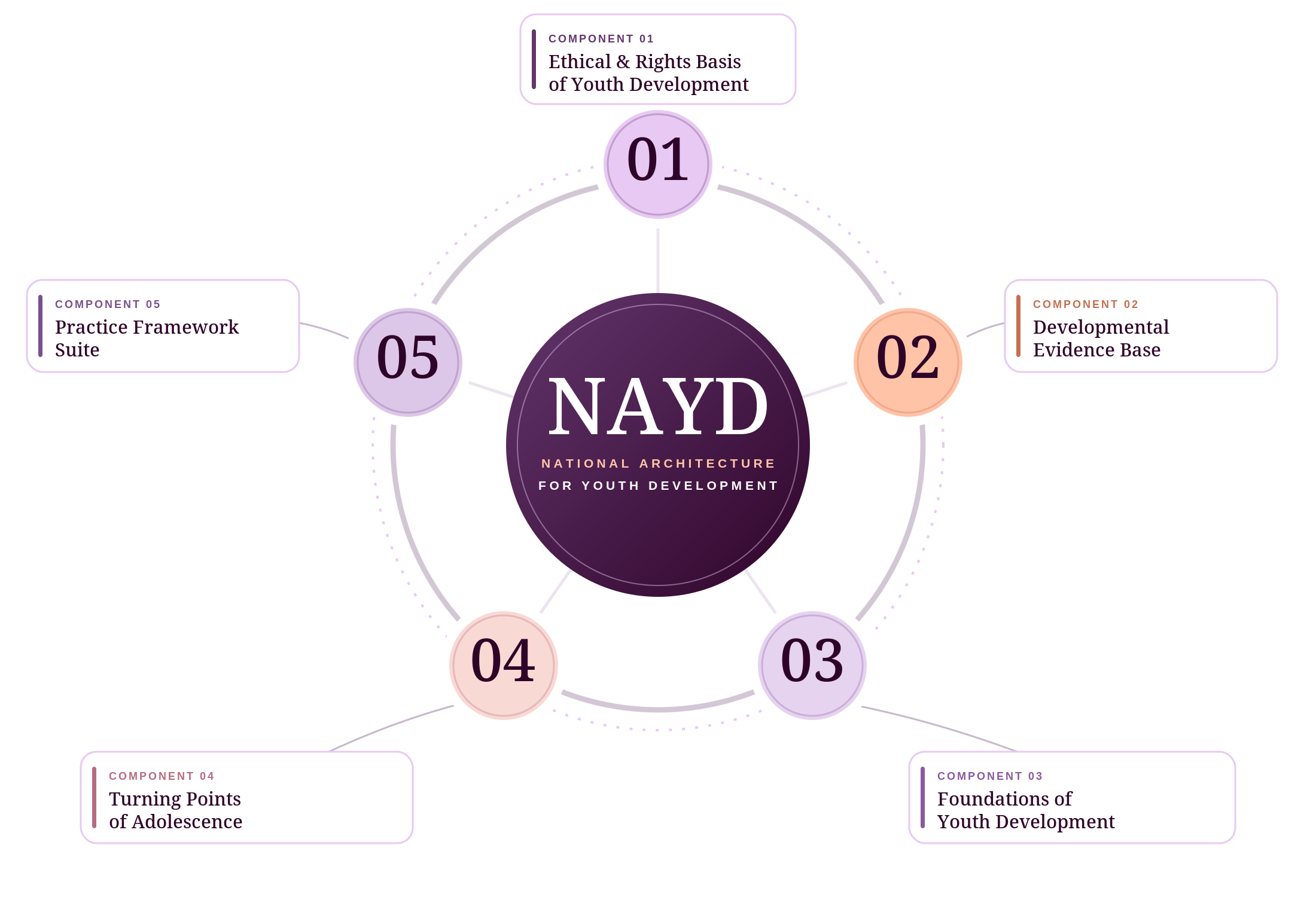
The whole is more than the parts.
01
ERB / ETHICAL & RIGHTS BASIS
What ought to guide our understanding?
Natural Equity and the UNCRC bring developmental fairness, dignity, rights and participation into focus. A developmental account should not reduce the young person to an institutional problem.
CONNECTION TO THE REST OF NAYD
The ethical and rights basis informs every other component. It does not replace statutory safeguarding or create independent legal powers.
An important distinction: the Ethical & Rights Basis is cross-cutting. Natural Equity and the UNCRC inform the interpretation of the entire architecture; the five components are interconnected, not sequential steps.
Select one of the five components. See what it contributes to an interconnected understanding of adolescence and why no component stands alone.
CHAPTER TWO / EXPLORE ONE DEVELOPMENTAL WORLD
The same experience. Five different questions.
Choose a fictional situation. Then select a NAYD component to explore what that perspective might help us notice. Change the lens without changing the young person.
02
Begin with a situation.
These examples are fictional and intentionally incomplete. They are not records to assess or situations to diagnose.
Changing accommodation and school
One experience, not five separate assessments. Changing the architectural perspective changes which questions become visible, not the young person's circumstances. All five components remain interconnected, with the Ethical & Rights Basis informing the whole architecture.
CHAPTER THREE / BRING PERSPECTIVES TOGETHER
Different windows into the same world.
Choose a professional perspective. Explore what could be visible, what may be less visible, and the particular knowledge that setting can contribute. Then compare it with another.
03
One young person. Different professional windows.
A young person has recently changed accommodation and moved to a different school. Some community relationships remain important to them. Explore what different professional settings might notice, what may be less visible, and what each perspective could contribute to a shared understanding.
“There's been a lot changing. I miss some things about where I used to live, but I still see people from my old community. I'm getting used to the new school, although everyone keeps asking me about different parts of what's happening.”
Fictional illustrative account — not an actual interview.Education
What changes when another profession joins the picture?
Add a second professional setting to explore where the two perspectives may complement each other and what could remain unknown.
Select another professional setting to reveal two perspectives side by side.
Different responsibilities. A more connected understanding.
What does the young person understand about the changes? Which connections matter to them? What may still be unknown? How could appropriate professional coordination preserve their dignity, participation and continuity?
A shared developmental architecture allows different professions to bring their knowledge into conversation without removing their distinct roles, responsibilities or statutory duties. The five components of NAYD offer interconnected ways to interpret developmental experiences. The Ethical & Rights Basis remains central throughout.
Illustrative learning experience. The descriptions are hypothetical and do not represent fixed professional competencies, information-sharing permissions or actual service arrangements. This is not a case assessment, information-sharing protocol, referral tool or substitute for safeguarding procedures.
CHAPTER FOUR / CONTEXT CHANGES INTERPRETATION
What changes when circumstances change?
Explore separate contextual details that could alter how an experience is understood. These choices are not a cumulative score and do not predict a developmental outcome.
04
The event stays the same. The context can change.
A young person moves accommodation and begins attending a different school. Explore how changes in timing, relationships, continuity, access and opportunity might influence what the same transition means.
What else might matter?
Select a circumstance to explore its possible developmental significance.
This is one possible interpretation, not a prediction of how the young person will experience the change.
What happens when contexts overlap?
Add several fictional circumstances to the same experience. Explore how they might interact without treating their number as a measure of risk or severity.
NAYD encourages attention to developmental timing, structural conditions, relationships, opportunity and the young person's own account. A change may create difficulty, continuity, possibility or several meanings simultaneously. No combination of fictional circumstances can determine a Turning Point or replace appropriate professional judgement and statutory responsibilities.
CHAPTER FIVE / A SHARED DEVELOPMENTAL PICTURE
What becomes visible together?
A reflection on the fictional experience and perspectives you explored. This is a recap of learning, not a case formulation, recommendation or professional record.
05
THE CENTRAL INTENTION
Development happens together.
Young people experience one life, even when organisations see different parts of it. NAYD offers shared developmental perspectives without asking every profession to become the same — or treating any single institution's view as the whole story.